How to Select a Submersible Sewage Pump for Real Duty
A submersible sewage pump is not selected by discharge size alone. Two pumps with the same outlet can have different hydraulic curves, impeller passages, motor ratings and limits on starts, submergence or solids.
If you are working out how to select a submersible sewage pump, start with the system and the waste stream. The model comes later.
Define the flow range before looking at a catalogue
Record minimum, normal and peak inflow. For a lift station, the pump duty is not automatically equal to peak inflow: the number of pumps, usable wet-well volume and permitted drawdown determine how the station cycles and how much capacity each unit needs.
A duplex station may be arranged as duty/standby, duty/assist or alternating duty. Those descriptions are not interchangeable. State whether one pump must carry the design peak with the other unavailable, or whether two pumps are expected to run together.
Also record the lowest practical flow. A large pump selected only for a rare storm peak may run for very short periods during dry-weather inflow, producing frequent starts and poor wet-well turnover.
Calculate head at more than one wet-well level
The total head includes:
- Difference between the wet-well liquid level and discharge boundary
- Pressure required at the discharge boundary
- Friction through the force main, valves and fittings
- Velocity-head difference where it is material
Static head changes as the wet well fills and empties. Force-main friction changes with flow and condition. Plot at least a low-head and high-head system curve rather than handing the supplier one isolated duty point.
The operating point is where the selected pump curve meets the current system curve. The Hydraulic Institute notes that this intersection moves when levels, valves, piping condition or the number of running pumps change.
Describe the solids, not just the liquid
“Wastewater” is too broad for submersible sewage pump selection. A supplier needs to know whether the stream contains:
- Soft organic solids
- Wipes, cloth or long fibres
- Food waste or grease
- Sand, grit or other abrasive particles
- Occasional hard objects
- Corrosive chemicals or high chloride levels
Free-passage diameter is useful, but it does not fully describe rag handling. A nominally large passage can still collect stringy material around the impeller eye. Conversely, a cutting or grinder mechanism may reduce fibrous material but introduce a different maintenance requirement and may not be suitable for heavy grit.
Ask for the actual impeller type, clear-passage definition and application limits. Do not turn “non clog sewage pump” into an absolute promise; no pump is immune to every object that can enter a sewer.
Match the hydraulic design to the waste stream
Common wastewater impeller arrangements include channel, vortex, semi-open and cutting or grinding designs. Each trades hydraulic efficiency, passage size and resistance to blockage differently.
A vortex design keeps much of the flow away from the impeller but may sacrifice efficiency. A channel impeller can be efficient at its intended duty yet sensitive to the shape and amount of fibrous material. A cutting design is useful when reducing fibres is part of the duty, but its wear parts and clearances must remain serviceable.
The right solids handling pump is therefore the one whose hydraulic passage and service history match the incoming material—not the one with the most aggressive product name.
Check every operating point, not only design flow
On the manufacturer curve, mark:
- One pump at minimum static head
- One pump at maximum static head
- All intended parallel-pump combinations
- Any emergency or high-level operating point
- The minimum continuous or intermittent flow stated by the manufacturer
Then check efficiency, absorbed power and NPSH over that envelope. At high wet-well level, lower static head can move the pump farther right, increasing flow and sometimes motor load. At low level, suction conditions and submergence become more restrictive.
The pump must remain inside its permitted operating region. A duty point touching the curve is not enough.
Confirm the motor and protection arrangement
For an industrial wastewater submersible pump, record voltage, frequency, phase, cable length, starting method and maximum starts per hour. Ask whether the motor relies on the pumped liquid for cooling and what minimum submergence applies.
Protection may include winding-temperature sensors, moisture detection, overcurrent, phase-loss or phase-imbalance protection and a high-level alarm independent of the normal level controller. The protection scheme must match the supplied motor and local electrical rules.
Do not bypass a repeated thermal trip to keep the station running. A trip may point to a blocked impeller, wrong duty point, voltage problem, excessive starts or inadequate cooling.
Make removal and maintenance part of the selection
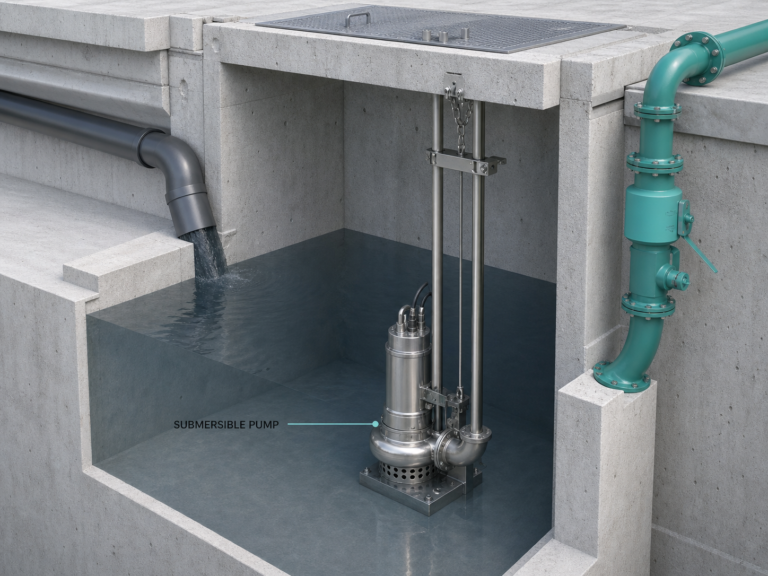
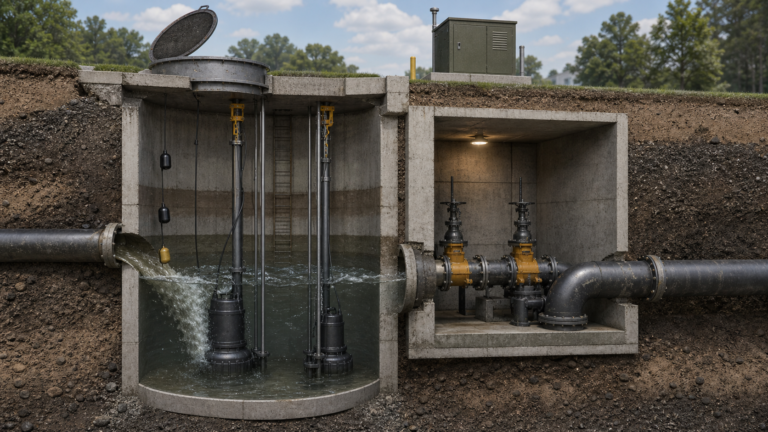
A sewage pump for lift station service needs more than a pump and cable. Confirm:
- Guide rails and auto-coupling arrangement
- Lifting chain and rated hoist access
- Isolation and non-return valves
- Valve-chamber drainage and safe access
- Level sensors and high-level alarm
- Space to remove the pump without dismantling discharge piping
- Availability of impeller, seal, bearing and cable-entry parts
The cheapest pump can become the expensive option if every inspection requires confined-space entry or if wear parts are unavailable.
A compact enquiry example
Consider this illustrative duty sheet:
- Normal inflow: 12 L/s
- Peak inflow: 28 L/s
- Required arrangement: two pumps, duty/assist, with one pump handling normal flow
- Total head envelope: 13 to 19 m depending on wet-well level and force-main condition
- Liquid: municipal sewage at 10–35°C
- Expected material: wipes and soft solids; occasional grit
- Discharge main: 150 mm, with stated length, material, fittings and discharge level
- Power: 400 V, 50 Hz, three phase
- Installation: guide-rail wet well with separate valve chamber
Those inputs allow a manufacturer to plot one- and two-pump operation and discuss impeller choice. “Please quote a 150 mm submersible pump” does not.
SHXINHUO’s sewage pump range, submersible pump range and cutting pumps cover different wastewater conditions. Final selection requires the exact curve, solids description, installation layout and electrical duty.
What to send with the enquiry
Send the flow range, head calculations, liquid and solids description, minimum and maximum wet-well levels, pipe layout, operating sequence, power supply and required materials. Add photographs or samples of troublesome material when blockage is already occurring.
That information does more to produce a reliable selection than adding a vague safety margin to flow and head.
Technical references
- Hydraulic Institute — Five Tips to Improve the Pump Selection Process
- Hydraulic Institute Data Tool — Combined Pump and System Curves
- U.S. EPA — Wastewater Technology Fact Sheet: In-Plant Pump Stations
- Hydraulic Institute Data Tool — Submergence
Data note
The enquiry example is illustrative and is not a SHXINHUO product selection. Final pump capacity, passage size, motor rating, cycling limit and submergence must come from current data for the exact supplied model.