Why Does a Sewage Pump Clog? Diagnose the Whole Station
When a sewage pump keeps clogging, the quickest response is often to fit a larger passage or a cutting impeller. That can work, but only when the blockage mechanism has been identified.
The better question is not simply why does a sewage pump clog. It is: what entered the station, where did it collect, and what hydraulic condition allowed it to stay there?
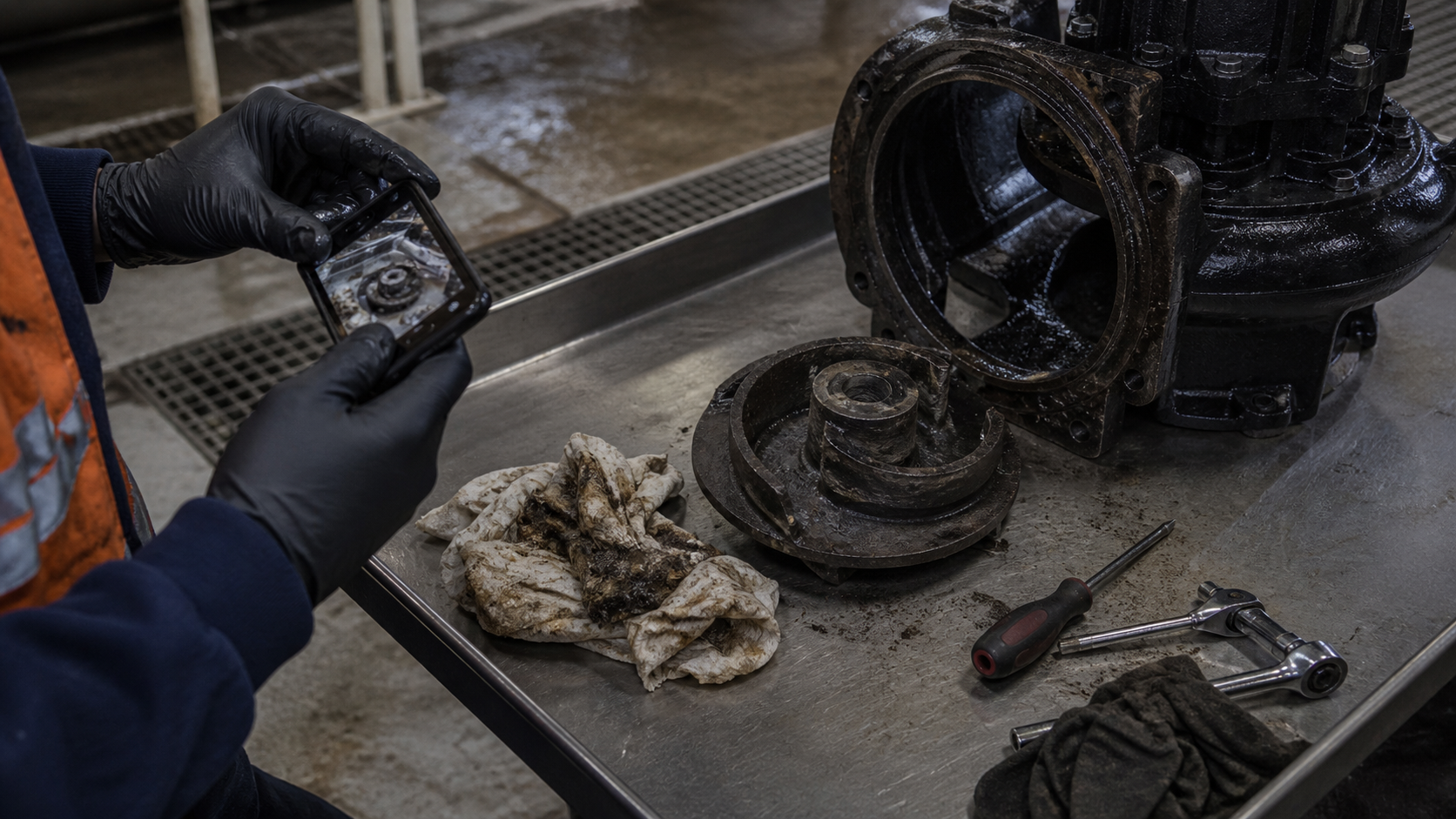
Start with what was removed
Do not discard the obstruction before recording it. Photograph and classify the material:
- Wipes or cloth wrapped around the impeller
- Rope-like fibres at the inlet
- Grease-bound mats
- Hard debris lodged in a passage
- Sand or grit restricting clearances
- A mixture collected on level controls or guide rails
A pump clogged by wipes needs a different response from a pump jammed by stones. If the same material appears after every repair, the evidence is already pointing beyond the motor or bearing.
Record the date, wet-well level, running current, flow if available and which pump was leading. Patterns matter: blockage after low-flow nights, after a process discharge or only when two pumps run can each suggest a different cause.
Wipes and fibres do not behave like round solids
Sphere-passage figures are useful for hard solids. Flexible wipes can fold, stretch and join into ropes. They may pass a nominal opening yet wrap around a vane or shaft.
The U.S. EPA lists fats, oils, grease and household products—including items marketed as flushable—as causes of sanitary sewer overflows. Grease makes the problem worse by binding fibres into a mass.
For persistent fibres, compare channel, vortex and cutting hydraulics using representative material. A pump for fibrous wastewater should be selected from evidence of rag behaviour and service history, not only a brochure passage diameter.
Check whether the pump is operating where it was designed to operate
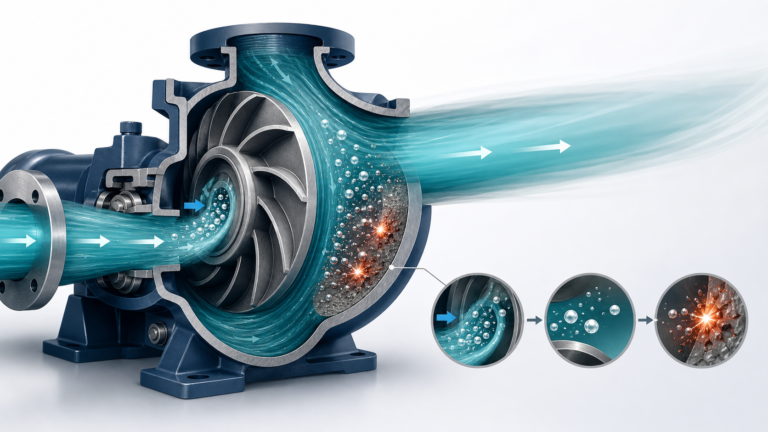
A pump running far left of its curve produces less through-flow than expected and can experience recirculation and unstable hydraulic loading. A pump running too far right may overload, cavitate or pull the wet well down too quickly.
Plot the measured or calculated system curve against the current pump curve. Check:
- Actual static head at start and stop levels
- Force-main friction at one- and two-pump flow
- Valve position and check-valve condition
- Actual rotation and speed
- Wear that may have reduced head and flow
Low delivered flow can leave solids in the wet well and force main. Adding a more powerful pump without calculating the new operating point can exchange clogging for overload or surge.
Inspect the wet well, not only the volute
Wet well grease on walls, floats and guide rails shows that the station is storing material between cycles. Flat floors, dead zones and long retention can allow solids to settle and then arrive at the pump as a concentrated slug.
Look for:
- Deposits below the pump-off level
- Floating mats above normal operating level
- Stagnant corners
- Inlet flow striking a pump or level sensor
- Air-entraining vortices at low level
- A start/stop band that encourages many short cycles
Cleaning the impeller but leaving the wet well unchanged resets the clock rather than fixing the cause.
Confirm the impeller and wear clearances
An open or semi-open impeller can lose performance as the clearance increases. Reduced performance changes the operating point and can weaken solids transport.
Inspect the leading edges, cutter surfaces, wear plate, volute and any anti-rag features. Compare measured clearances with the service manual. Check for incorrect reassembly after maintenance.
A non clog sewage pump still needs its intended clearances. Wear, corrosion or a damaged vane can defeat the hydraulic feature that made the pump suitable in the first place.
Review the controls and starts
Frequent starts can be caused by a narrow level band, leaking check valve, small working volume or unstable level signal. Short runs may not establish the flow needed to move settled material through the discharge main.
Compare start counts between duty units. If one pump blocks repeatedly while its partner does not, check rotation, clearance, cable connection, guide-rail seating and actual performance rather than blaming the wet well alone.
A check valve that leaks back can make the pump move the same parcel of wastewater repeatedly. A valve that does not open fully adds head and reduces flow.
Decide where material should be controlled
Possible responses include:
- Source-control work to reduce wipes, rags or grease
- Upstream screening where maintenance and disposal are practical
- A better-matched solids-handling impeller
- A cutting or grinder pump for confirmed fibrous duty
- Wet-well benching or mixing changes
- Revised start/stop levels and pump sequence
- Force-main cleaning or pipe-size correction
Screening and grinding are different strategies. Screening removes material from the wastewater and creates a handling task. Grinding reduces particle size but sends the material downstream.
A disciplined blockage report
Before requesting a replacement pump, send:
- Photographs of removed material and damaged parts
- Pump model, impeller type and measured clearances
- Flow, head, current and wet-well levels before the event
- Start count and run time by pump
- Force-main size, length, profile and valve arrangement
- Cleaning history and known grease or grit condition
SHXINHUO’s sewage pumps, submersible pumps and cutting pumps address different wastewater conditions. The failure evidence determines which hydraulic approach deserves evaluation.
The decision point
Repeated clogging can come from the incoming waste, wet-well geometry, low station flow, worn hydraulics, controls or the wrong impeller. More than one cause may be active.
Change the pump only after the station explains the failure. Otherwise, the new unit may simply become a cleaner place for the same blockage to form.
Technical references
- U.S. EPA — Sanitary Sewer Overflow Frequently Asked Questions
- U.S. EPA — Guide for Evaluating CMOM Programs at Sanitary Sewer Collection Systems
- U.S. EPA — Wastewater Technology Fact Sheet: Screening and Grit Removal
- Hydraulic Institute Data Tool — Combined Pump and System Curves
Data note
The troubleshooting sequence is general guidance. Wastewater maintenance involves electrical, biological and confined-space hazards; site procedures, isolation and qualified personnel take priority.