Water Hammer in Pumping Systems: A Fast Event with Long-Term Consequences
The pipe moves, the check valve slams and the pressure gauge needle jumps. A few seconds later, the system appears normal.
That short event is easy to dismiss. Repeated pressure surges can loosen supports, damage seals, fatigue joints and shorten the life of valves and instruments. A severe event can exceed a pipe or pump casing pressure rating in one cycle.
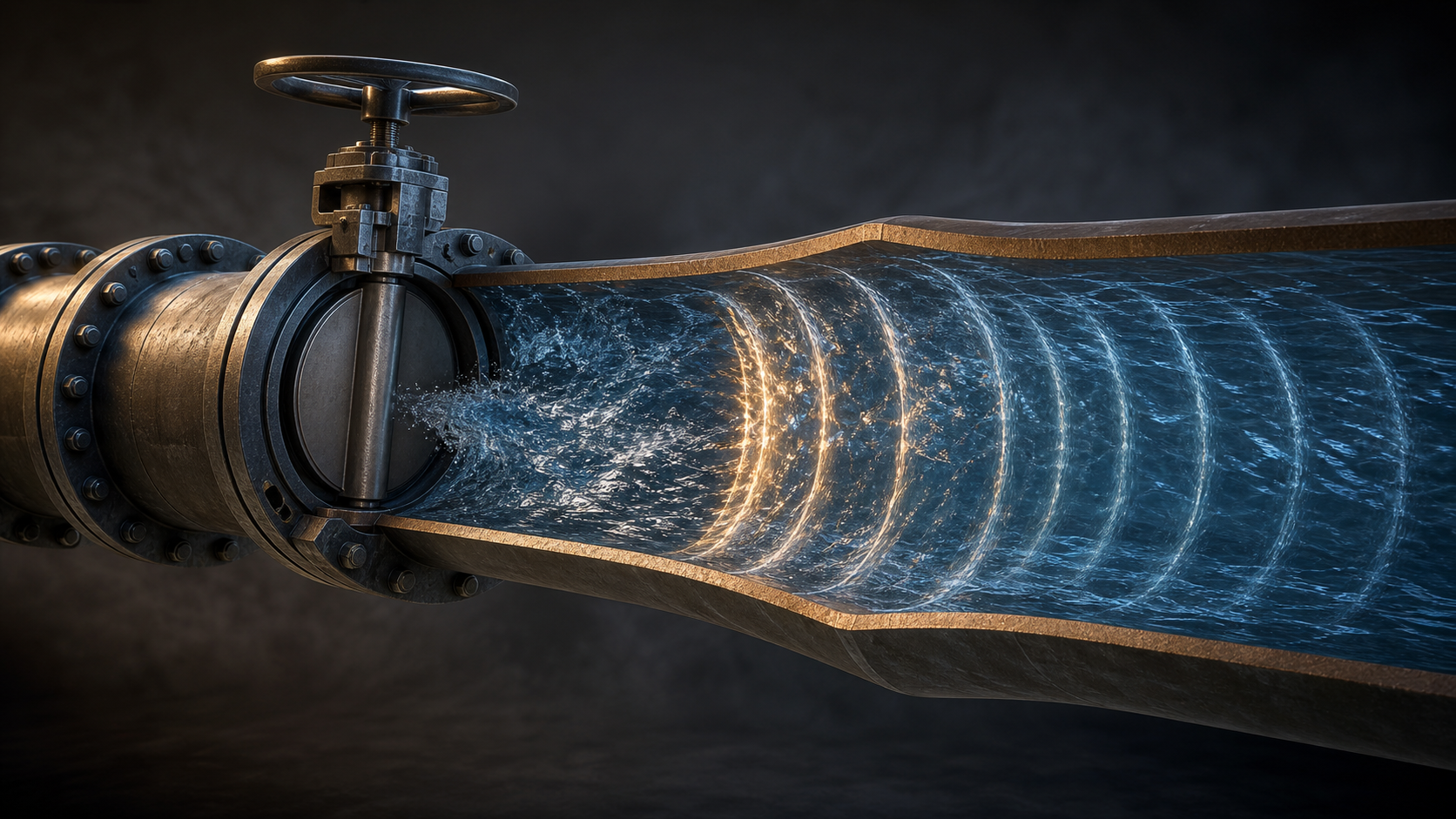
Water hammer is a transient pressure wave caused by a rapid change in liquid velocity. In pumping systems, common triggers include a power failure, an emergency pump trip, fast valve movement and reverse flow followed by check-valve closure.
It is not solved by choosing a pump with a larger motor. The event belongs to the complete pipe system and its control sequence.
What happens after the velocity changes
Liquid in a long pipe has momentum. When a valve closes or a pump stops, that moving column cannot change velocity everywhere at the same instant. The liquid and pipe wall compress and deform slightly, creating a pressure wave that travels through the system.
The wave reflects at reservoirs, valves, changes in pipe area and other boundaries. Positive and negative pressure waves can combine. A low-pressure phase may be as important as the high-pressure peak because it can lead to column separation, air ingress or local vapour formation. When separated columns rejoin, the return surge can be severe.
This is why the loudest slam is not always the maximum pressure event and why a single gauge near the pump may not capture the worst location.
A useful screening equation
For an effectively instantaneous velocity change, the Joukowsky equation estimates pressure change:
Δp = ρ × a × Δv
where:
- Δp is pressure change in pascals
- ρ is liquid density in kg/m³
- a is pressure-wave speed in m/s
- Δv is change in liquid velocity in m/s
For water with ρ ≈ 1,000 kg/m³, a pressure-wave speed of 1,000 m/s and a velocity change of 1.5 m/s:
Δp = 1,000 × 1,000 × 1.5 = 1,500,000 Pa
That is approximately 15 bar above or below the reference pressure, depending on the direction and phase of the transient.
The result changes linearly with wave speed:
| Assumed wave speed | Velocity change | Screening pressure change |
|---|---|---|
| 300 m/s | 1.5 m/s | 4.5 bar |
| 600 m/s | 1.5 m/s | 9.0 bar |
| 1,000 m/s | 1.5 m/s | 15.0 bar |
| 1,200 m/s | 1.5 m/s | 18.0 bar |
Pipe material, diameter, wall thickness, restraint and liquid properties influence wave speed. The table is not a design limit and does not replace a transient model.
Closure time decides whether the simple estimate applies
The Joukowsky result is most directly applicable when the velocity change occurs faster than the pressure wave can travel to a boundary and return.
For a simple pipeline, the wave reflection time is often screened as:
T = 2L ÷ a
For a 1,000 m line with a wave speed of 1,000 m/s, the reflection time is 2 seconds. A closure significantly faster than that is “rapid” for this screening purpose. A slower closure may produce a lower first pressure rise, although real networks still require analysis of reflections and control behaviour.
Do not apply a universal valve-closing time. The safe motion profile depends on pipeline length, wave speed, normal velocity and boundary conditions.
Four common pump-system triggers
1. Power failure or pump trip
Flow decelerates after torque disappears. In a rising main, liquid may reverse before the check valve closes. The rotating inertia of the pump and motor, the pump’s four-quadrant behaviour and the valve dynamics all affect the transient.
2. Check-valve slam
A check valve that waits for substantial reverse velocity before closing can stop that reverse flow abruptly. Valve type, size, orientation, spring setting and installation conditions matter more than the label “non-return valve.”
3. Fast control-valve movement
An actuator may be set for rapid shutdown without considering pipeline response. Both closing and opening can create harmful transients. A programmed multi-stage motion can sometimes reduce the event, but it should be validated.
4. Air and column separation
Entrapped air changes system compressibility and can either cushion or worsen an event depending on location and volume. Negative pressure can allow dissolved gas to come out of solution or a liquid column to separate. Air valves and vacuum protection must be selected for the required admission and release duty, not added as a generic cure.
Warning signs worth recording
Investigate when operators report:
- A sharp bang after pump stop
- Visible pipe or support movement
- Repeated check-valve noise
- Gauge spikes or unexplained high-pressure alarms
- Joint, instrument or seal failures after trips
- Vacuum readings or collapsed flexible sections
- Events that change with tank level or the number of running pumps
Record the time sequence: command, pump speed, flow, suction and discharge pressure, valve position and alarm status. High-speed data may be necessary; a slow building-management trend can miss a transient that occurs in fractions of a second.
Control measures must match the cause
Possible measures include:
- Controlled pump acceleration and deceleration
- A flywheel or higher rotating inertia where appropriate
- Check valves selected for dynamic response
- Slower or staged valve operation
- Surge vessels, hydropneumatic tanks or accumulators
- Air/vacuum valves at analysed locations
- Pressure-relief or anticipation valves
- Bypass lines or controlled recirculation
- Stronger pipe restraint and appropriate pressure class
Each measure changes the transient. A VFD ramp may help with commanded starts and stops but cannot maintain a normal ramp after complete power loss unless the system has the required energy and control arrangement. A surge vessel needs correct gas volume, pre-charge, connection size and maintenance.
Treat protective devices as part of the model, not as decorative insurance.
When a transient analysis is warranted
Use specialist analysis when the consequence or uncertainty is significant, particularly for:
- Long rising mains
- High normal velocities
- High static lift
- Large pump inertia or several pumps operating together
- Rapid valves
- Weak or thin-wall pipe
- Systems that can experience sub-atmospheric pressure
- Critical water, wastewater, fire or process service
- A history of unexplained failures
The model should examine normal starts and stops, power failure, valve malfunction, changing reservoir levels and credible pump combinations. Verify the assumed valve law and pump data; a detailed model with poor inputs still produces a poor answer.
SHXINHUO supplies pumps for building water supply and wastewater transfer. For long mains or high-head duties, a pump enquiry should include pipeline length, diameter, material, elevation profile, valve arrangement and control sequence as well as flow and head.
Water hammer happens quickly, but it usually leaves clues. Treat the first slam, pressure spike or moving pipe as data. It is cheaper to investigate the transient than to keep replacing the component that happened to fail first.
Technical references
- KSB — Water Hammer: Know-how for System Designers
- Hydraulic Institute — Waterhammer Resources
- Hydraulic Institute — Pump FAQs
Safety and data note
The Joukowsky values are screening calculations, not allowable pressures. Actual peaks can differ because of closure time, wave reflection, pipe elasticity, pump dynamics, air and protective devices. A qualified engineer should perform transient analysis where failure could injure people, release hazardous liquid or cause major damage.