Pipe Diameter and Pumping Cost: The Decision That Outlives the Pump
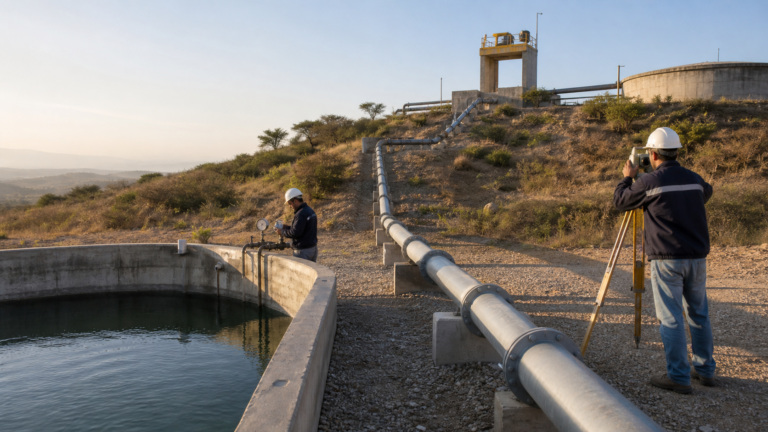
A pump can be replaced. Pipe embedded through a building or buried across a site is much harder to change.
That makes pipe diameter a life-cycle decision. A smaller line may reduce material and installation cost, but it increases velocity and friction. The pump then has to create extra head every hour the system operates. A larger line costs more upfront and usually reduces that recurring energy demand.
Neither “always use the larger pipe” nor “keep velocity below one fixed number” is a sound design rule. The right size comes from flow, liquid properties, route, allowable velocity, pressure class, installation cost and lifetime energy.
Why diameter has such a strong effect
For a fixed flow, velocity is:
v = Q ÷ A
and the cross-sectional area of a circular pipe is:
A = πD² ÷ 4
Reducing diameter therefore raises velocity quickly.
The Darcy-Weisbach equation expresses straight-pipe friction head as:
h f = f × (L ÷ D) × (v² ÷ 2g)
Friction depends on pipe length, internal diameter, velocity and friction factor. The friction factor depends on Reynolds number and relative roughness.
Diameter appears directly in the L/D term and indirectly through velocity squared. This is why a modest diameter change can produce a large head-loss change.
Worked example: four internal diameters
The following comparison uses:
- Water at approximately 20°C
- Flow: 60 m³/h
- Straight pipe length: 100 m
- Commercial-steel absolute roughness: 0.045 mm
- Combined pump and motor efficiency: 70%
- Operation: 4,000 hours per year
- Electricity tariff: $0.12/kWh
- Fittings, valves, elevation and equipment losses excluded
Friction factors are estimated from the Reynolds number and relative roughness; values are rounded.
| Internal diameter | Velocity | Straight-pipe friction head | Power for this friction only | Annual friction energy cost |
|---|---|---|---|---|
| 80 mm | 3.32 m/s | 13.20 m | 3.08 kW | $1,477 |
| 100 mm | 2.12 m/s | 4.26 m | 0.99 kW | $477 |
| 125 mm | 1.36 m/s | 1.39 m | 0.32 kW | $156 |
| 150 mm | 0.94 m/s | 0.56 m | 0.13 kW | $63 |
Moving from 80 mm to 125 mm cuts the calculated cost of straight-pipe friction by about 89% in this example—roughly $1,321 per year.
That is not the total pumping cost. Static lift, valves, fittings and end-use equipment still require head. It is the cost associated with 100 m of straight pipe alone.
Nominal size is not internal diameter
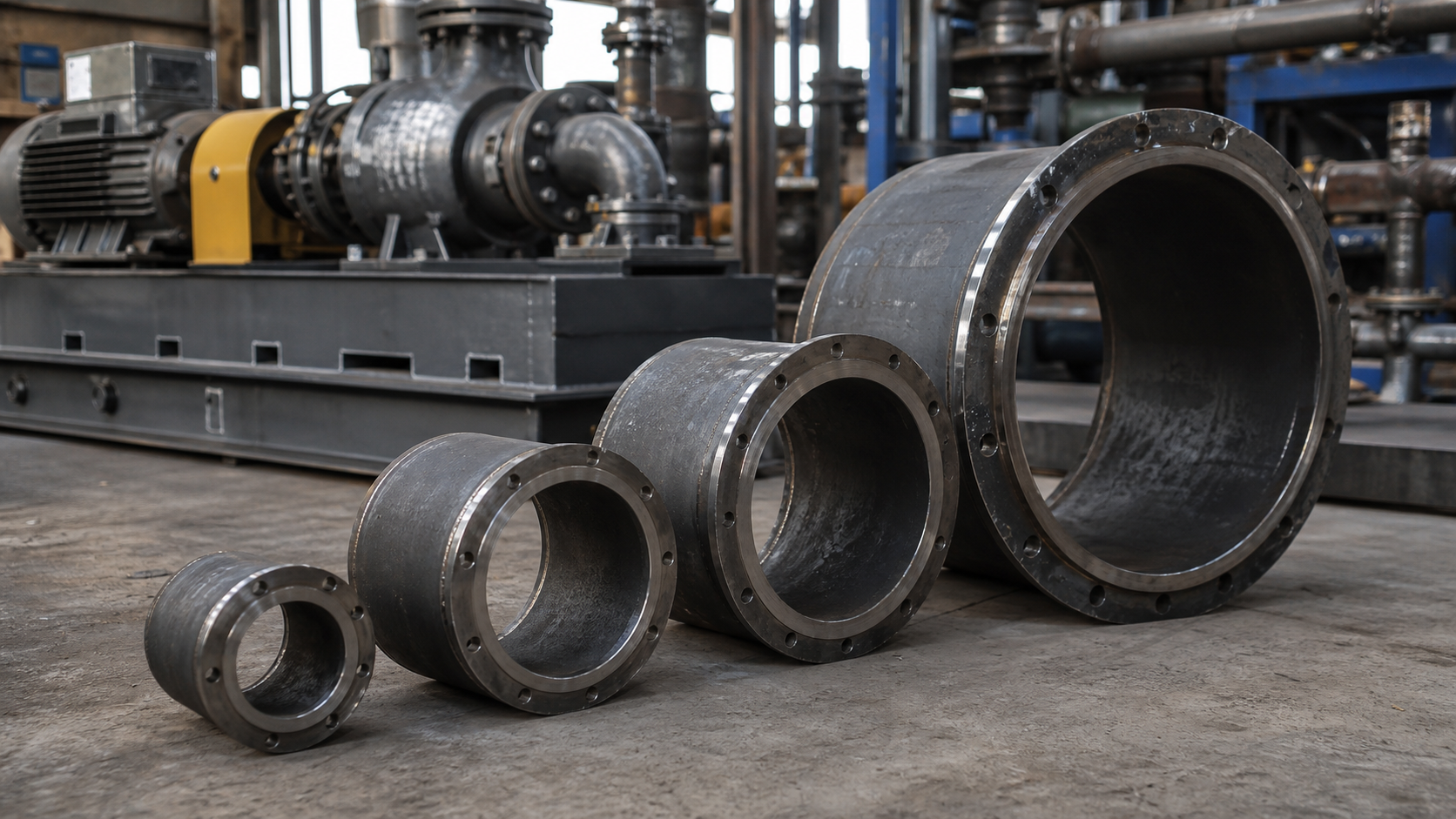
The table compares assumed internal diameters. Real pipe is sold by nominal size and schedule or wall class. Two pipes with the same nominal size can have different internal diameters.
Use the actual inside diameter for the selected material, pressure class and wall thickness. Lined pipe, corrosion allowance, scale or deposits can further reduce the effective flow area.
If a calculation reports “DN100” without the internal diameter, the result is not yet auditable.
Include the entire route
Straight-pipe loss is only one part of dynamic head. Add:
- Elbows, tees and reducers
- Isolation and control valves
- Check valves
- Strainers and filters
- Flow meters
- Heat exchangers and coils
- Nozzles and terminal equipment
- Entrance and exit losses
Use manufacturer pressure-drop data for equipment when available. For valves and fittings, use an accepted resistance coefficient or equivalent-length method consistently.
Dirty-condition loss deserves separate attention. A clean strainer pressure drop is not the value the pump will see just before the maintenance alarm.
Suction and discharge piping have different risks
High discharge friction primarily increases energy use and required pump head.
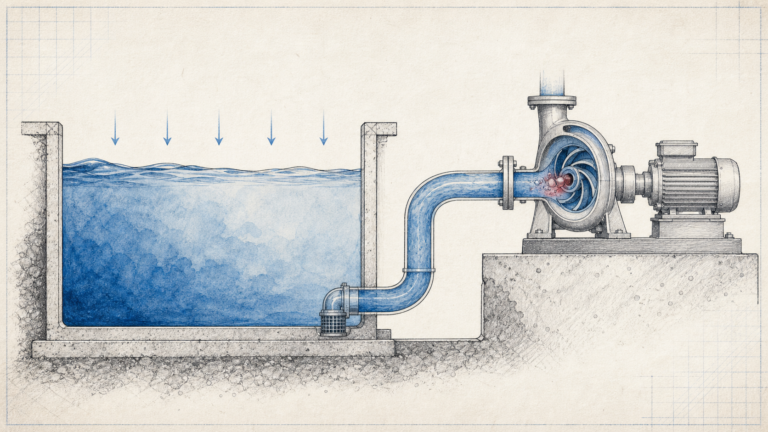
High suction loss reduces NPSH available at the impeller. An undersized suction pipe, obstructed strainer or poorly arranged elbow near the inlet can contribute to cavitation, noise and unstable performance.
The Hydraulic Institute advises considering flow, velocity, viscosity, total system length, restrictions and elevation when sizing pipe. Suction layout should also provide a uniform inlet flow profile. A short-radius elbow directly at the suction flange may cause distortion even when the calculated friction loss appears acceptable.
Do not select suction pipe solely by matching the pump nozzle. A reducer may be appropriate because the system pipe and pump connection serve different functions.
Large pipe is not free
Increasing diameter reduces friction but can raise:
- Pipe, fitting, valve and insulation cost
- Support loads and space requirements
- Installation labour
- Flushing or disinfection volume
- Liquid inventory
- Heat loss in temperature-controlled systems
- Retention time in low-demand water systems
In wastewater lines, excessive diameter can reduce velocity enough for solids to settle. In domestic water, local hygiene and turnover requirements may constrain oversizing. In process service, response time and product hold-up can matter.
The optimum is the lowest credible life-cycle cost that also meets hydraulic, operational and regulatory requirements.
Turn the comparison into a payback check
Suppose the installed 125 mm route costs $4,500 more than the 80 mm route. Using the illustrative annual energy difference of $1,321:
Simple payback = $4,500 ÷ $1,321 ≈ 3.4 years
That simple payback ignores discounting, tariff changes, maintenance and the possible difference in pump size. A formal life-cycle comparison should include those items, but the simple result is enough to show whether detailed costing is worthwhile.
Repeat the calculation for low, normal and peak flow. Because friction increases rapidly with flow, a line that appears acceptable at average duty may become expensive or restrictive at peak duty.
Existing systems: measure before replacing the pump
If a pump cannot reach the expected flow, do not assume the impeller is worn.
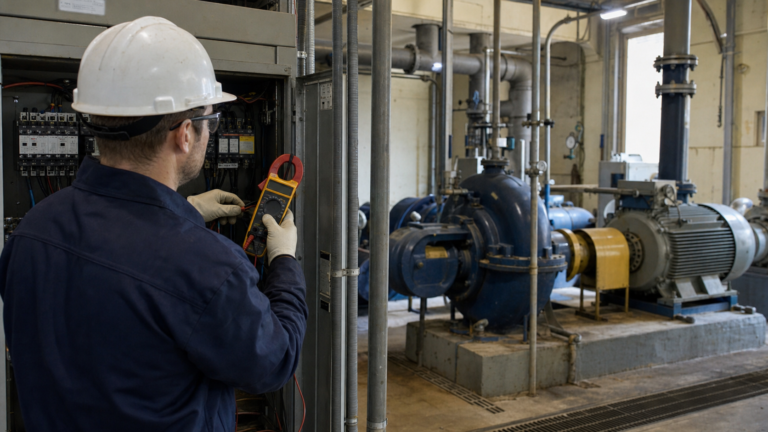
Measure suction pressure, discharge pressure, flow and valve position. Compare the resulting system head with the original calculation. Higher-than-expected friction can come from:
- A partly closed or failed valve
- A blocked strainer
- Scale, corrosion or biological growth
- A narrower replacement component
- An undocumented route change
- More fittings than shown on the drawing
A larger pump can force more flow through the restriction, but it also hides the system problem and increases energy use.
A practical pipe-size decision sheet
For each candidate diameter, compare:
- Actual internal diameter and material
- Velocity at minimum, normal and maximum flow
- Straight-pipe and fitting loss
- Equipment pressure drop
- Required pump head and input power
- Annual hours in each load band
- Installed pipe and valve cost
- Maintenance, fouling and future-capacity assumptions
- Noise, solids, hygiene and local code limits
- Life-cycle cost over the intended project period
SHXINHUO’s pump selection team can review flow and head requirements for building-services and transfer duties. The best enquiry includes the pipe route and operating profile, not only a motor rating or flange size.
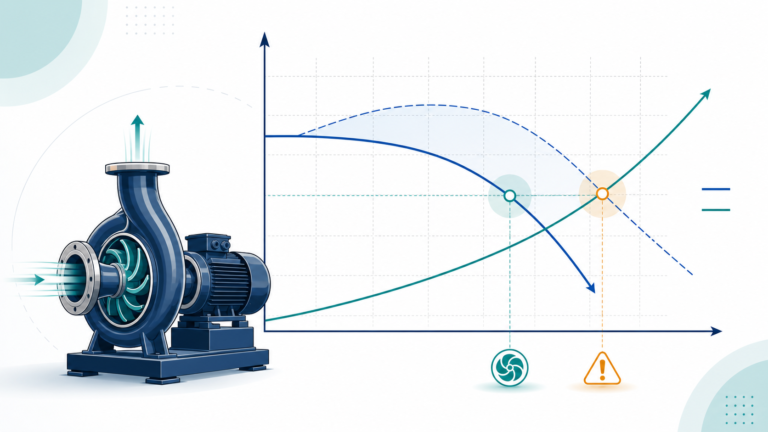
Pipe diameter is often decided before the pump model. That is appropriate: the system curve should define the pump duty. If the pipe is chosen only on first cost, the pump may spend its whole life paying for that decision.
Technical references
- Hydraulic Institute Data Tool — Frictional Losses in Pipes
- Hydraulic Institute Data Tool — Pipe Frictional Losses
- U.S. Department of Energy — Reduce Pumping Costs Through Optimum Pipe Sizing
- Hydraulic Institute — Eight Tips to Boost Pump Piping Efficiency
Data note
The worked values are screening calculations for the stated assumptions, using a Swamee-Jain approximation for the Darcy friction factor. Actual internal diameter, roughness, viscosity, fittings, ageing and duty profile will change the result.