
How to Reduce Pump Energy Consumption Without Guessing
Replacing a motor or adding a VFD can save energy, but neither is a diagnosis. A pump may be efficient at its own operating point while the system wastes head across a valve or sends unused flow through a bypass.
To reduce pump energy consumption, measure the service first: flow, head, electrical input and operating hours.
Establish the current energy baseline
Record at representative loads:
- Suction and discharge pressure
- Flow rate
- Pump and motor speed
- Electrical input power
- Valve and bypass position
- Number of pumps operating
- Tank levels or system configuration
Use the same measurement boundaries when comparing before and after conditions. A lower motor current is not proof of a saving if flow or required pressure has also fallen below the process need.
Annual electricity is straightforward:
Annual energy = average input power × operating hours
For an illustrative pump drawing 37 kW for 6,000 hours per year:
37 × 6,000 = 222,000 kWh/year
If a verified system change reduces average input to 29 kW while delivering the same required service:
(37 − 29) × 6,000 = 48,000 kWh/year saved
At an illustrative electricity price of USD 0.12/kWh, that equals USD 5,760 per year before maintenance or demand-charge effects.
Find where the excess head goes
Compare pump head with the head the process actually needs. Excess is often visible as:
- A throttling valve mostly closed
- A bypass or recirculation line continuously open
- Pressure-reducing valves dissipating pump head
- Unnecessarily high pressure setpoints
- A pump operating far from its best-efficiency region
The Hydraulic Institute’s pump-and-system curve guidance shows that the pump operates where its curve meets the current system curve. Closing a valve adds resistance; it does not make an oversized pump appropriately sized.
Correct the requirement before buying equipment
Improve pumping system efficiency by asking whether the system can require less head:
- Reduce avoidable pipe and valve loss
- Clean fouled strainers, exchangers and pipes
- Eliminate unnecessary bypass flow
- Lower an excessive pressure setpoint
- Move the pressure sensor to a representative location
- Separate high- and low-pressure users where practical
A new energy efficient pump will still waste energy if the system forces it to generate head that is immediately destroyed across a control valve.
Use speed control where the system supports it
For a centrifugal pump under affinity-law assumptions, flow changes roughly with speed, head with speed squared and power with speed cubed. That makes speed reduction attractive in variable-flow systems.
But VFD pump savings depend on the system curve. A friction-dominated closed loop can often reduce head sharply at lower flow. A high-static-head transfer system has a fixed lift that speed control cannot remove.
Before fitting a drive, plot reduced-speed pump curves against minimum and maximum system curves. Check motor cooling, drive efficiency, resonance, minimum process flow and NPSH. Do not claim cube-law savings from speed percentage alone.
Consider impeller trimming for a permanent mismatch
Impeller trimming reduces the energy added by a centrifugal pump and can suit a system with a stable, permanently lower requirement. The U.S. Department of Energy identifies excessive throttling, open bypasses, high noise or vibration and operation far from the design point as signs that trimming may deserve evaluation.
Trimming is not an exact cube-law exercise. It can change efficiency and NPSH characteristics, and the final curve should come from the pump manufacturer or a verified test. If a correctly sized impeller is available, replacing it may be preferable to machining.
Sequence parallel pumps around real demand
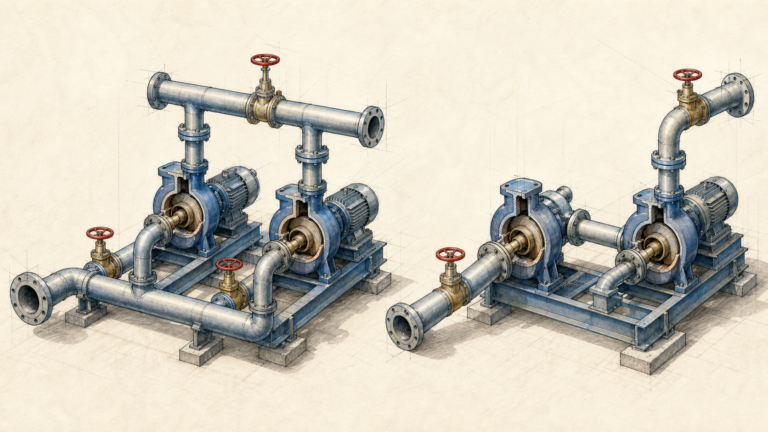
Multiple pumps are often installed for capacity and redundancy. Their control should also keep the operating units in useful parts of their curves.
At light demand, one pump may be more efficient than two heavily reduced units. At higher demand, staging another pump can reduce the head and speed each unit must produce. Use composite curves and measured efficiency rather than equal-flow assumptions.
The U.S. Department of Energy documented a booster-system retrofit in which three smaller adjustable-speed pumps replaced a mismatched arrangement. Annual electricity fell from 280,400 to 55,300 kWh, an 80% reduction. That result followed measurement and right-sizing; it is not a standard VFD saving for every booster system.
Restore performance before replacing the pump
Wear rings, impellers, clearances, bearings and seals can gradually reduce performance. Operators may open a valve or increase speed to compensate, hiding the loss in the electricity bill.
A pump energy audit should compare current head, flow and power with the expected curve. If the pump once met the duty efficiently, restoring internal clearances or correcting alignment may be the lowest-cost action.
Also check the motor load. A lightly loaded oversized motor can operate at lower efficiency and power factor, but changing the motor without correcting an oversized pump leaves the main hydraulic loss untouched.
Rank projects by verified annual value
For each proposed change, document:
- Baseline flow, head, input power and annual hours
- Required service after the change
- Expected operating points across the load profile
- Annual energy and cost difference
- Maintenance and reliability effects
- Installation cost, downtime and payback
Include uncertainty. A project based on one pressure reading and estimated hours should not be presented with the precision of a logged measurement campaign.
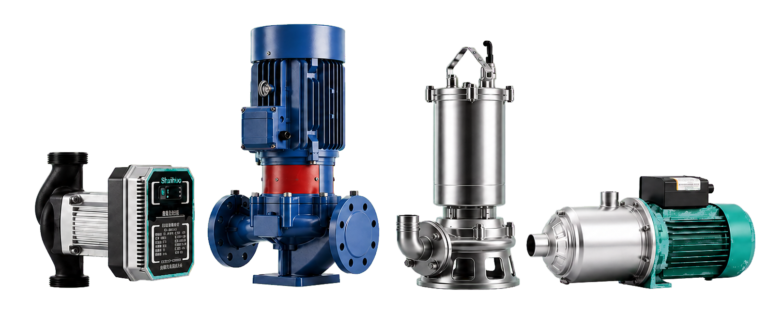
SHXINHUO’s ISG inline pumps, CDL vertical multistage pumps and TD multistage pipeline pumps cover different duties. For a replacement enquiry, provide the measured load profile and system curves so efficiency can be compared where the plant actually operates.
The useful question
Do not ask only, “Can we install a more efficient pump?” Ask, “What flow and head does the process need each hour, what are we supplying, and where is the difference being lost?”
That question separates a measurable energy project from an equipment purchase with an optimistic percentage attached.
Technical references
- U.S. Department of Energy — Improving Pumping System Performance
- U.S. Department of Energy — Pump Systems Resources
- Hydraulic Institute Data Tool — Combined Pump and System Curves
- U.S. Department of Energy — Water Booster Pump Case Study
Data note
The 37 kW example and electricity price are illustrative. Energy decisions should use measured input power, verified operating hours, the local tariff and confirmed post-project operating points.