NPSH Available vs Required: A Worked Calculation That Changes with the Site
A pump curve may show NPSHR of 3.2 m. The project calculation may show NPSHA of 5.1 m. Subtract one from the other and the job appears finished: there is 1.9 m of margin.
That arithmetic is easy. The difficult part is making sure the 5.1 m represents the worst condition the pump will actually see.
NPSH available is controlled by the system. Tank level, site elevation, liquid temperature, suction-pipe losses and pressure above the liquid all affect it. NPSH required is supplied by the pump manufacturer for a defined flow, speed and liquid. Treating either value as fixed can turn a satisfactory selection into a noisy, unreliable installation.
The two values come from different places
The Hydraulic Institute defines NPSHA as the absolute suction head at the pump datum minus the liquid’s absolute vapour-pressure head. It is calculated by the system designer.
NPSHR is a pump characteristic supplied by the manufacturer. Current Hydraulic Institute guidance distinguishes the manufacturer’s NPSHR from the tested NPSH3 value. NPSH3 is the test condition at which cavitation has already caused a 3% reduction in first-stage head. The manufacturer-supplied NPSHR should be equal to or greater than that tested value.
This distinction matters. Matching NPSHA to NPSH3 does not describe cavitation-free operation. At NPSH3, the pump has reached a measurable head breakdown criterion.
A practical NPSHA equation for an open tank
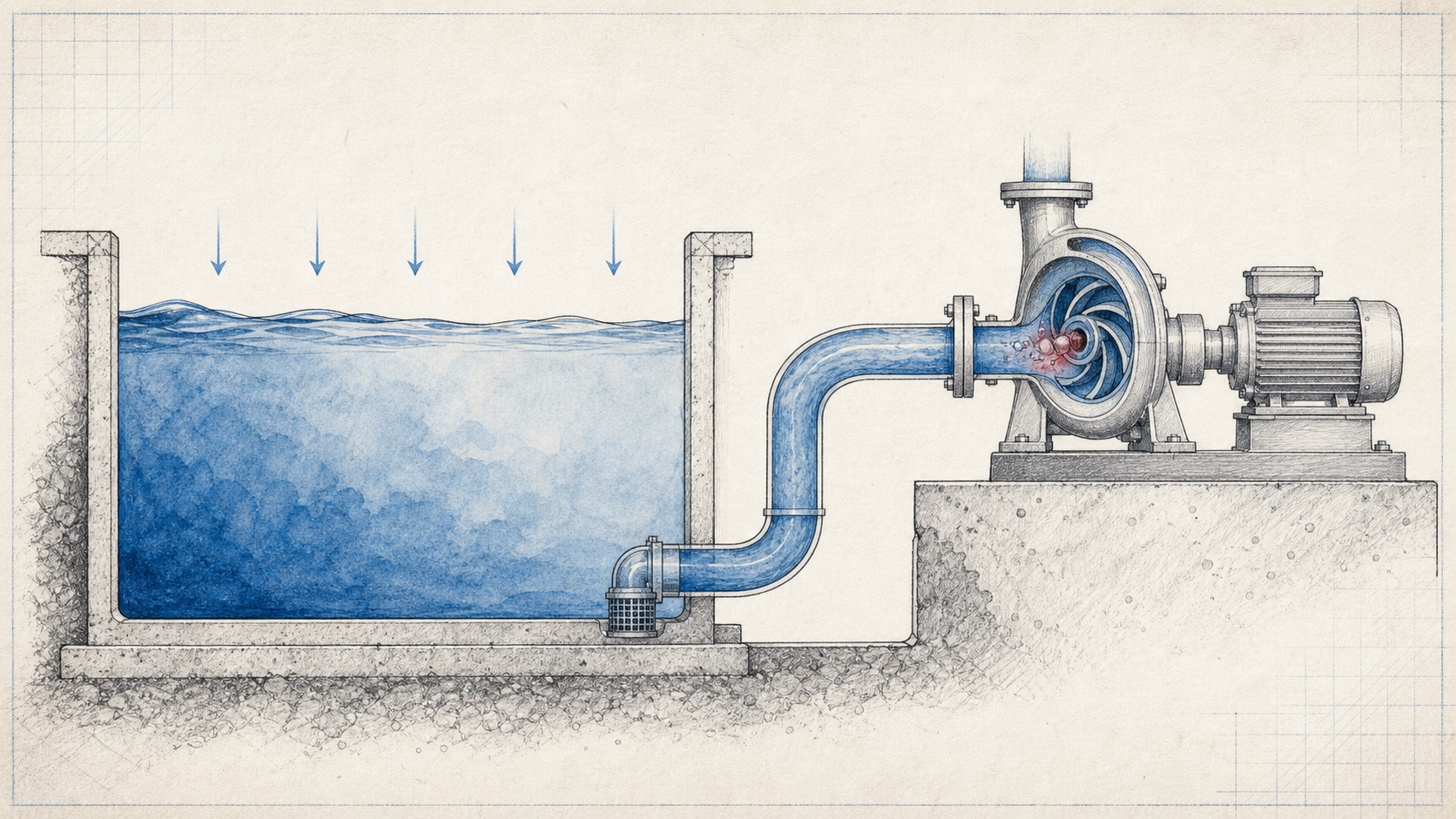
For a pump drawing water from an open tank, a useful metric form is:
NPSHA = atmospheric-pressure head + static suction head − suction losses − vapour-pressure head
Static suction head is positive when the liquid surface is above the pump datum and negative when the pump is above the liquid.
Consider this illustrative installation:
- Open tank at sea level
- Pump centreline 2.0 m above the minimum liquid level
- Suction-pipe and fitting loss of 1.2 m at maximum flow
- Water temperature of 60°C
- Atmospheric-pressure head of approximately 10.33 m of water
- Vapour-pressure head of approximately 2.03 m at 60°C
The calculation is:
NPSHA = 10.33 − 2.0 − 1.2 − 2.03 = 5.10 m
If the pump’s NPSHR at maximum operating flow is 3.2 m, the simple difference is:
NPSH margin = 5.10 − 3.20 = 1.90 m
The ratio is:
NPSHA ÷ NPSHR = 5.10 ÷ 3.20 = 1.59
Those figures describe the example, not a universal acceptance rule. The required margin depends on the pump design, application, operating region, liquid and consequences of cavitation. Use the current manufacturer recommendation and the applicable edition of ANSI/HI 9.6.1.
Temperature removes margin faster than many duty sheets show
At 20°C, water vapour pressure is only about 2.34 kPa, equivalent to roughly 0.24 m of water head. At 60°C it is about 19.9 kPa, or approximately 2.03 m. At 80°C it is close to 47.4 kPa.
Using the same sea-level installation at 20°C:
NPSHA = 10.33 − 2.0 − 1.2 − 0.24 = 6.89 m
Raising the water temperature to 60°C reduces NPSHA from 6.89 m to 5.10 m without changing the pipe, tank or pump.
Do not use the normal room-temperature value for a hot-water cleaning cycle, condensate service or a tank exposed to seasonal heating. Record the maximum liquid temperature that can coincide with maximum flow and minimum tank level.
Site elevation changes the atmospheric term
Atmospheric pressure falls with elevation. At an illustrative elevation of 1,500 m, an atmospheric pressure near 84.6 kPa corresponds to approximately 8.63 m of water head.
For the same 60°C suction arrangement:
NPSHA = 8.63 − 2.0 − 1.2 − 2.03 = 3.40 m
The pump has not changed, but the calculated margin above 3.2 m has fallen from 1.90 m to only 0.20 m.
The exact atmospheric pressure varies with weather as well as altitude. A final design should use a conservative site value, not a rounded sea-level constant.
Suction loss must be calculated at the highest relevant flow
Pipe friction rises roughly with the square of flow in a turbulent water system. If the suction loss is 1.2 m at the design flow, it will be higher at an overload or run-out condition.
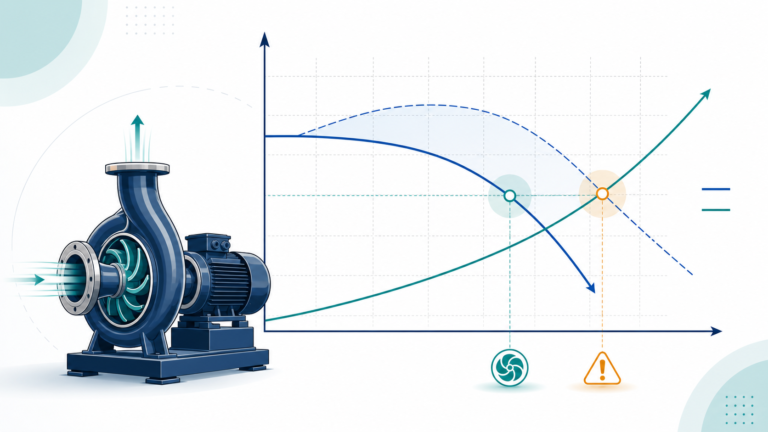
The NPSHR curve often rises with flow too. This creates a double penalty:
- The system supplies less NPSHA because suction loss increases.
- The pump demands more NPSHR at the higher flow.
For that reason, compare NPSHA and NPSHR across the expected operating range. Checking only the normal duty point can miss the worst condition.
Include the losses through:
- Suction pipe
- Entrance
- Bends and reducers
- Isolation valve
- Strainer or screen
- Flow meter or other suction-side equipment
A clean-strainer calculation should not be the only case if the operating procedure allows a meaningful pressure drop before cleaning.
Four details that commonly corrupt the calculation
Using gauge pressure instead of absolute pressure. Vapour pressure and suction pressure must be handled on an absolute basis in the NPSH equation.
Measuring level from the floor. Static suction head is referenced to the pump’s defined datum, normally related to the first-stage impeller, not to the plant floor.
Mixing pressure and head without density. A pressure value in kPa must be converted to head using the actual liquid density.
Ignoring pressure above a closed vessel. A pressurised suction tank adds pressure head; a vessel under vacuum removes it. Use the minimum absolute surface pressure permitted by the process.
What to change when the margin is weak
Start with the system before selecting a larger motor or a higher-speed pump. Neither creates NPSHA.
Practical options may include:
- Lowering the pump relative to the minimum liquid level
- Increasing suction-pipe diameter
- Shortening the suction route
- Removing unnecessary fittings
- Selecting a lower-NPSHR hydraulic design
- Reducing maximum flow or speed
- Increasing minimum vessel pressure where the process permits
- Lowering liquid temperature before transfer
For multistage duties, a CDL vertical multistage pump and a TD multistage pipeline pump can reach similar duty regions with different layouts. The correct choice still depends on the exact curve, first-stage NPSHR and the site calculation.
The useful NPSH question is not “Is NPSHA greater than NPSHR today?” It is “What is the smallest margin at the hottest liquid, lowest level, lowest atmospheric pressure, dirtiest permitted strainer and highest operating flow?”
Technical references
- Hydraulic Institute Data Tool — Pump Principles and NPSH
- Hydraulic Institute — Understanding the 2024 Updates to ANSI/HI 9.6.1
- NIST Chemistry WebBook — Water Vapour-Pressure Data
Data note
The worked values use rounded atmospheric and water-property data to explain the calculation. They are not a project guarantee or a product-curve value. Final NPSHA should be calculated with the project datum, actual liquid properties and conservative site conditions.